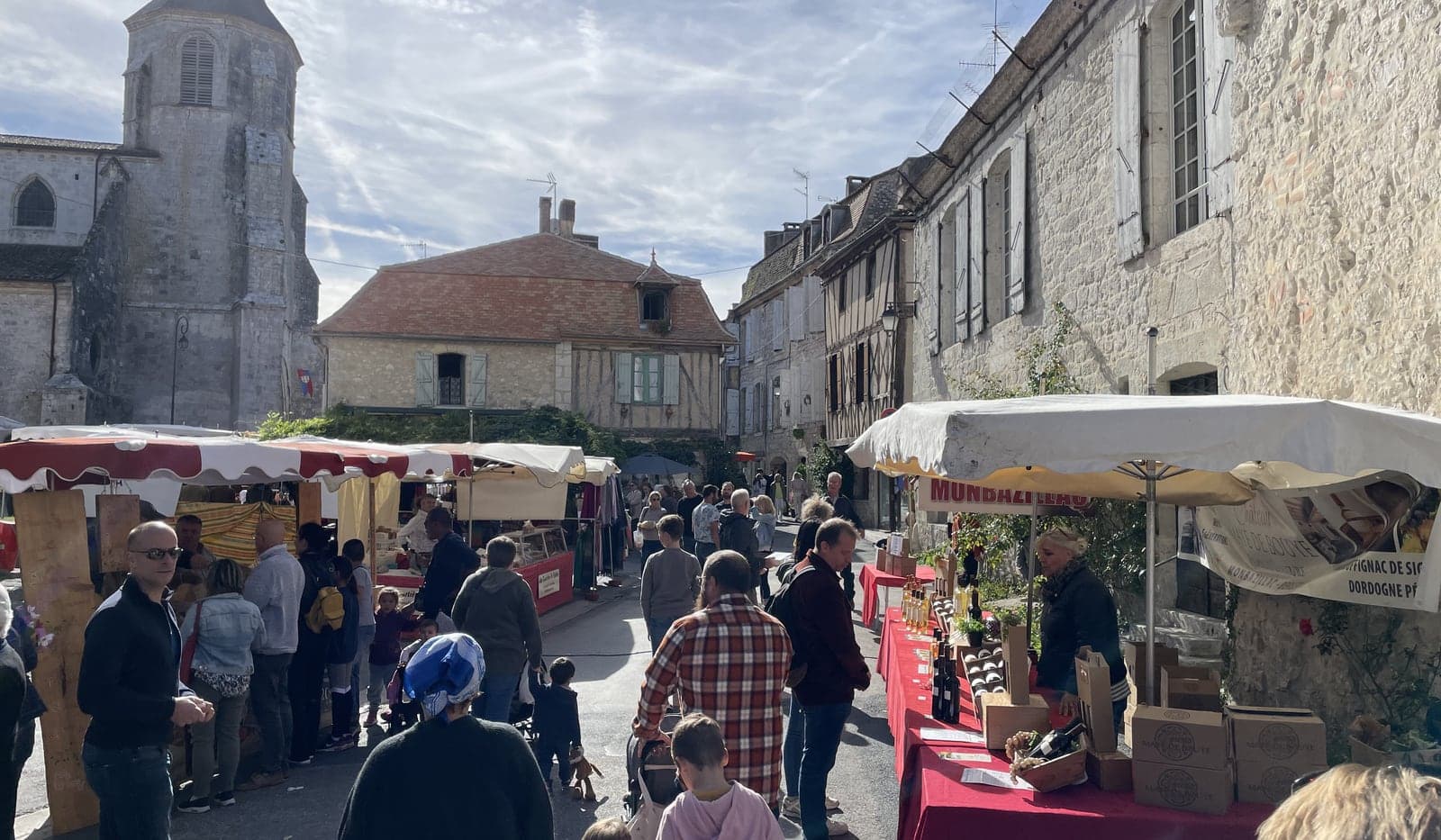
Every single day of the week, somewhere in the Dordogne, a market sets up its stalls. This is your complete guide to the best markets for each day — from quiet village squares to the magnificent Saturday spectacle in Sarlat.
Market day is the social and culinary anchor of rural French life, and in the Dordogne the tradition runs particularly deep. Unlike the uniform supermarkets that have colonised much of French retail, the weekly markets remain genuinely local: producers arrive direct from their farms, the selection shifts with the season, and the sense of place is irreducible. For anyone staying in a holiday rental Dordogne — especially a private villa or farmhouse with its own kitchen — the weekly market calendar is not merely a tourist attraction. It is the backbone of the week.
Monday: Terrasson-Lavilledieu
Terrasson-Lavilledieu sits on the northern edge of the Périgord Noir, where the landscape softens into the Vézère valley. Its Monday morning market is busy, largely local, and refreshingly free of souvenir tat. This is where you will find mushroom vendors piling cèpes and girolles high in autumn, reliable charcuterie from farms in the surrounding hills, and a particularly good honey stall that has been in the same family for three generations.
Size: medium. Character: genuinely local. From a typical Périgord Noir villa base near Sarlat, Terrasson is around 35 minutes north on the D704 — well worth the drive if you happen to be heading toward the Corrèze or visiting the extraordinary Les Jardins de l'Imaginaire. Insider tip: the covered hall on the main square handles meat and cheese year-round; the outdoor stalls are where the seasonal magic happens.
Tuesday: Périgueux
Tuesday brings one of the best reasons to visit the Périgueux city market, which radiates out from the Place du Coderc and surrounding streets in the old town. This is a large, confident city market — Périgueux is the prefecture of the Dordogne département — and it reflects that scale. You will find specialist olive and tapenade merchants from Provence, serious fromagers, butchers who still know the name of the farm, and a flower section that makes the square almost impossibly pretty in spring.
Size: large. Character: mix of local regulars and serious food shopping. Périgueux is roughly 75 minutes northwest of Sarlat — plan to pair the market with a visit to the remarkable Cathédrale Saint-Front and a lunch in the Gallo-Roman quarter. Insider tip: arrive by 8am for the best selection at the cheese and poultry stalls; the market winds down quickly after midday.
Wednesday: Sarlat & Sainte-Alvère
Sarlat (mid-week)
The Wednesday market in Sarlat-la-Canéda is the quieter, more local sibling of the famous Saturday event. It occupies the Place de la Liberté and a handful of surrounding lanes, with a selection focused firmly on fresh produce, bread, and a few farm stalls rather than the curated regional-product stands that appear at the weekend. Many of our guests find that Wednesday is actually their preferred market day in Sarlat — the town breathes more easily, the locals are at ease, and you can take your time in front of the walnut oil vendor without feeling rushed.
Size: medium. Character: local and relaxed. From any villa with pool Dordogne in the Sarlat environs, you are typically no more than 20 minutes away. Insider tip: the boulangeries on the Rue de la République fill up with market-goers mid-morning; go early for the best bread.
Sainte-Alvère (truffle market, in season)
Every Monday from mid-November through to mid-March, the small village of Sainte-Alvère hosts one of the region's most respected truffle markets — but on selected Wednesdays during peak season it also holds a publicly accessible truffle exchange that is fascinating to observe even if you are not buying wholesale. The Tuber melanosporum, the black Périgord truffle, is weighed, inspected, and traded here with a quiet intensity that makes it feel more like a financial exchange than a food market.
Size: small but significant. Character: professional and seasonal. Sainte-Alvère is approximately 45 minutes west of Sarlat. Insider tip: prices are set each week and posted visibly — typically ranging from €600 to over €1,000 per kilogram depending on quality and season. Even buying a modest 20–30g for home cooking is transformative, and the advantage of a full kitchen in a private villa means you can actually do something memorable with it that evening.
Thursday: Domme
Domme is one of the great bastide villages of the Dordogne, perched on a dramatic cliff above the Dordogne River with views that stop first-time visitors in their tracks. Its Thursday morning market is compact but well-curated — perhaps 30 to 40 stalls in and around the Place de la Halle — and the combination of medieval architecture and good local produce makes it one of the most atmospheric market experiences in the region.
Look for local goat's cheeses, seasonal vegetables from the river valley, and excellent walnuts in autumn (Domme sits at the heart of walnut country). Size: small to medium. Character: scenic, mildly touristy in high summer but reliably local in spring and autumn. From Sarlat, Domme is just 12 minutes by car. Insider tip: the market is best enjoyed as part of a morning — park outside the village, take the bastide gateway on foot, shop, then walk the ramparts before the crowds arrive.
Friday: Le Bugue
The Friday market in Le Bugue is one of those pleasing discoveries that rewards guests who stay long enough to work through the full market week. Le Bugue is a working agricultural town on the Vézère River, and its Friday market reflects that — this is where local farmers come to sell rather than to perform. Expect serious vegetable stalls, excellent poultry including the famed canard gras, and one of the best selections of regional charcuterie you will find outside Sarlat's Saturday market.
Size: medium. Character: authentic and agricultural. Le Bugue sits about 30 minutes northwest of Sarlat. Insider tip: the covered market hall in the centre of town operates year-round and is worth exploring even outside market hours — several excellent local producers sell direct from small units inside.
Saturday: Sarlat — The Main Event
If you do only one market during a family holiday Dordogne, it should be the Saturday morning market in Sarlat. This is, without exaggeration, one of the finest weekly food markets in France. The entire medieval centre of the city transforms: the Place de la Liberté, the Rue de la République, the lanes around the cathedral, the side streets and covered passages — all of it fills with stalls from around 8am until approximately 1pm.
The scale is impressive but what elevates it is the quality and the genuine regionality. You will find:
- Foie gras from farms across the Périgord — whole lobes, terrines, mi-cuit preparations, rillettes. Prices are fair and provenance is clear; most vendors will explain their production method if asked.
- Walnut products in extraordinary variety: cold-pressed walnut oil, walnut wine (vin de noix), whole walnuts, walnut cake, walnut confectionery.
- Seasonal produce of exceptional quality — strawberries from the Lot-et-Garonne in early summer, cèpes and truffles in autumn, forced vegetables through winter.
- Cheese, including excellent cabécou (the small rounds of goat's cheese that are as much a symbol of the Périgord as the truffle).
- Bread and pastry from several excellent boulangeries that set up stands rather than make you queue at the shop.
- Linens, pottery, lavender sachets, and regional crafts in the outer sections.
From October through March, the Saturday market expands further to incorporate the weekly truffle and foie gras market — a spectacle in itself. Black truffles are sold by weight from wooden boxes, and the smell alone is worth the trip.
Practical notes: Arrive before 9am to move freely and secure the best produce. Parking fills up fast — the car parks on the periphery are well-signposted and a 10-minute walk is preferable to circling the centre. Bring cash (most stalls accept it; some do not take cards). Bring a large shopping bag or a cool box if you are buying charcuterie or foie gras. Leave before noon if crowds trouble you. Sarlat is the obvious anchor for anyone deciding where to stay in the Dordogne — being within 20 minutes means you can do this market every Saturday of your stay without effort.
Insider tip: the best foie gras vendors are invariably the ones with the longest queues. The patience is rewarded.
Saturday also: Périgueux
For those based in the northern Périgord, Périgueux also holds a significant Saturday market — larger than Tuesday's and with more specialist food stalls. If Sarlat feels too far or too busy, Périgueux's Saturday market around the Place du Coderc is a genuine alternative with its own pleasures.
Sunday: Les Eyzies & Belvès
Les Eyzies-de-Tayac
Les Eyzies, the self-styled world capital of prehistory (the Musée National de Préhistoire is here, and the Lascaux caves are 25 minutes north), hosts a Sunday morning market that is small but charming — perhaps 20 stalls in the village square, heavy on seasonal produce and regional products. It is an ideal warm-up to a day exploring the Vézère valley caves and troglodyte sites. From Sarlat, Les Eyzies is about 20 minutes northwest.
Belvès
Belvès is one of the most beautiful and underappreciated towns in the southern Périgord Noir. Its Sunday market in the medieval Place d'Armes — a square of covered arcades known as the couverts — is genuinely local and genuinely lovely. Stallholders here have been coming for decades; the selection is modest in size but high in quality, with particularly good honey, vegetables, and seasonal fruit. Belvès is around 25 minutes south of Sarlat. Insider tip: walk the seven belfries and the extraordinary troglodyte dwellings beneath the town hall before or after the market.
The Villa Kitchen Advantage
There is a particular pleasure in market shopping that only becomes fully available when you are staying in a private holiday home in the countryside with its own kitchen. In a hotel, the beautiful cèpes you spotted at 8am on Saturday morning remain a beautiful memory. In a self-catering villa, they become dinner.
This is the rhythm that the Dordogne rewards and that a luxury holiday Périgord in a private property makes possible: you arrive at the market with no fixed plan, you buy what is extraordinary that morning — a jar of black truffle shavings, a lobe of duck foie gras, a kilo of ripe tomatoes from a farm three kilometres away, a round of cabécou that is exactly two days old — and by evening those things are on your table, cooked simply, in the kitchen of your stone farmhouse, with a bottle from the nearby Bergerac vineyards open beside you. The advantage of a full kitchen is not just convenience; it is an entirely different relationship with the food and the region.
Many of our guests find that the market calendar becomes the structural rhythm of the week — Tuesday in Périgueux, Wednesday at home in the garden, Saturday in Sarlat, Sunday a quiet wander around Belvès. A private pool means the afternoons are accounted for. The mornings belong to the markets.
Frequently Asked Questions
What time do markets start and finish in the Dordogne?
Most markets begin setting up from around 7:30–8am and are fully operational by 9am. The best produce — particularly foie gras, truffles, and artisan cheese — tends to sell out or be picked over by 11am. Most markets wind down between noon and 1pm. Arriving early is always rewarded.
Do I need cash at Dordogne markets?
Cash remains the preferred currency at most farm stalls and smaller vendors. Larger market traders and specialist foie gras producers increasingly accept card payments, but it is wise to carry €50–€80 in cash to avoid disappointment. There are ATMs in Sarlat, Périgueux, and Le Bugue.
When is truffle season at the Dordogne markets?
The black Périgord truffle (Tuber melanosporum) is in season from late November through to early March, peaking in January and February. During this period, Sarlat's Saturday market expands significantly to include truffle vendors, and specialist truffle markets operate in Sainte-Alvère and Périgueux. Small quantities suitable for home cooking can be purchased from as little as €25–€40 per serving.
Which is the best market in the Dordogne for first-time visitors?
Saturday morning in Sarlat is the answer for almost everyone — it is the largest, the most complete, and the most atmospheric. However, if you are visiting in high summer and crowds are a concern, the Wednesday market in Sarlat or the Thursday market in Domme offer very similar produce in a far more relaxed setting.
Is the Sarlat market suitable for families with children?
Absolutely. The Sarlat Saturday market is lively, visually stimulating, and full of tastings — cheese samples, honey tastings, slices of walnut cake. The medieval streets provide natural space to spread out. Younger children may find the foie gras preparation displays confronting, so be prepared for questions. A family holiday Dordogne anchored near Sarlat allows you to build the Saturday market into the weekly routine.
Can I buy foie gras directly from producers at the market?
Yes — and this is one of the great pleasures of the Dordogne markets. Many vendors at Sarlat's Saturday market and at Périgueux are selling product from their own farms. You can buy whole raw lobes (for cooking at home), mi-cuit preparations (semi-cooked, requiring refrigeration), and fully preserved terrines. Expect to pay €25–€45 for a quality whole lobe; prices for processed products vary widely by preparation and packaging.
What other regional products should I look for at Dordogne markets?
Beyond foie gras and truffles, look for: cold-pressed walnut oil (irreplaceable in salad dressings); cabécou goat's cheese; vin de noix (walnut aperitif wine); confit de canard; locally produced honey, particularly acacia and chestnut varieties; seasonal cèpes and other wild mushrooms from September through November; and strawberries from the Périgord in May and June, which are among the finest in France.
How far are the main markets from a villa near Sarlat?
Using central Sarlat as a reference point: Domme is 12 minutes; Les Eyzies is 20 minutes; Le Bugue is 30 minutes; Belvès is 25 minutes; Terrasson is 35 minutes; Sainte-Alvère is 45 minutes; Périgueux is 75 minutes. Staying in a villa with pool Dordogne near Sarlat gives you the best access to the widest range of markets throughout the week.
If the idea of building a week around markets, farmhouse kitchens, and the unhurried rhythm of Périgord life appeals to you, the properties in the Dordogne Collection have been chosen with exactly that kind of stay in mind. Each villa is positioned to make the region's best experiences — including its extraordinary markets — genuinely accessible. Browse our collection to find your ideal base in the Dordogne.