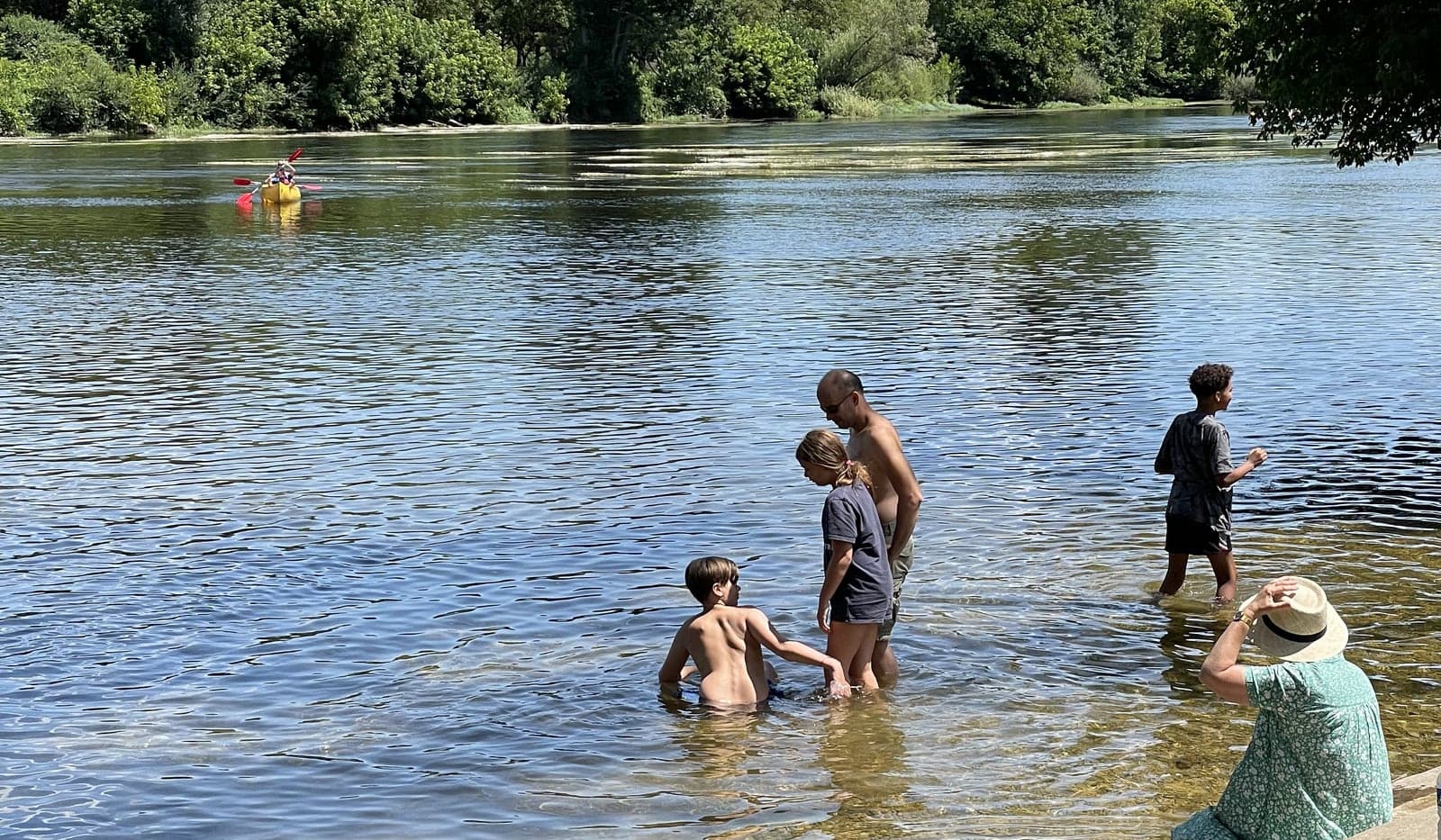
Wanneer de temperaturen in hartje zomer boven de 35°C stijgen, worden de rivieren, meren en rustige étangs van de Dordogne onmisbaar. Dit is een eerlijke gids voor de mooiste zwemplekken in de regio — van bewaakte rivierstrandjes tot verborgen natuurlijke bochten — én een eerlijke blik op de momenten waarop het privézwembad van je villa simpelweg wint.
De Dordogne in juli nodigt bijna elke dag uit tot verkoeling aan het water. Het water in de rivier kantelt rond eind juni naar comfortabel — niet lauw, maar dat soort verkoelend dat na een ochtend op een verhitte markt in Sarlat ineens onmisbaar wordt. Je drijft op je rug, kijkt omhoog naar gouden kalkstenen kliffen, en denkt: waarom kom ik hier niet elk jaar? Bewaakte rivierstrandjes met snackbars en badmeesters, spiegelgladde meren omzoomd door eiken, stille bochten in de Vézère waar je het water voor jezelf hebt — vanuit een stenen farmhouse of villa met zwembad ben je er meestal binnen twintig minuten. Dit is onze gids.
De rivierstrandjes van de Dordogne — Plages Fluviales
De rivier zelf vormt het kloppende hart van zwemmen in deze regio. Breed en groen slingert de Dordogne door een van de meest gefotografeerde landschappen van Frankrijk. Langs de oevers vind je een reeks plages fluviales — echte rivierstrandjes met zand- of kiezeloevers, ondiepe instapplaatsen en, in juli en augustus, toezicht door badmeesters. De waterkwaliteit van de Dordogne-rivier krijgt in de jaarlijkse Europese zwemwaterbeoordelingen consequent uitstekende scores, dus daar hoef je je geen zorgen over te maken.
Vitrac Port
Vitrac Port is waarschijnlijk het populairste rivierstrand van de zuidelijke Périgord — en met reden. Het ligt in een brede bocht van de rivier, met uitzicht op beboste kliffen, heeft een echt zandstrand, ondiep water dat ideaal is voor jonge kinderen, en in het hoogseizoen doorgaans toezicht van een badmeester van ongeveer 10.00 tot 19.00 uur. Er is een snackbar, toiletten en voldoende parkeergelegenheid. In augustus kan het strand druk worden — kom vóór 10.00 uur of na 17.00 uur voor een rustigere ervaring. Afstand vanaf Sarlat: ongeveer 7 kilometer, of circa 12 minuten met de auto. Veel van onze gasten kiezen dit als hun vaste eerste optie voor een ochtendduik.
Carsac-Aillac
Enkele kilometers stroomopwaarts ligt het rivierstrand van Carsac-Aillac, iets minder bekend en daardoor ook rustiger. De oever is op sommige stukken gras in plaats van zand, maar het zwemmen is er uitstekend — een lang, kalm stuk rivier met een zachte stroming. De voorzieningen zijn eenvoudig: parkeren, toiletten en een picknickplaats. Er is geen snackbar, dus neem je eigen lunch mee en maak er een ontspannen ochtend van. Afstand vanaf Sarlat: ongeveer 10 kilometer, rond de 15 minuten. Een fijne keuze voor gezinnen die een minder drukke sfeer zoeken zonder ver te hoeven rijden.
La Roque-Gageac
De rivierbocht bij La Roque-Gageac — een van de mooiste dorpen van Frankrijk, met zijn goudkleurige kalkstenen kliffen en troglodietentuinen — heeft een bescheiden plage fluviale waar het vooral om de omgeving draait. Zwemmen is hier geschikt voor zelfverzekerde zwemmers; de stroming kan levendig zijn en er is geen badmeester. Maar wil je op je rug drijven terwijl je omhoog kijkt naar een middeleeuwse rotswand met gierzwaluwen boven je hoofd, dan is er bijna geen mooiere plek. Parkeren kan op de dorpsparking, betaald in de zomer. Afstand vanaf Sarlat: 12 kilometer, ongeveer 18 minuten.
De Vézère-vallei — natuurlijke bochten en rustige plekken
De Vézère-rivier, die bij Limeuil samenkomt met de Dordogne, biedt een heel andere zwemervaring. Hier vind je geen bewaakte stranden — dit is zwemmen in de natuur op zijn puurst. De samenvloeiing bij Limeuil zelf is een prachtige plek: een kiezelbank waar de groene Vézère samenkomt met de bredere Dordogne, met open uitzicht en een ondiepe instap. Verder stroomopwaarts bieden rustige bochten bij Le Bugue en Les Eyzies helder en kalm zwemwater, al heb je lokale kennis — of een betrouwbare aanbeveling — nodig om de beste instapplekken te vinden. Afstand van Sarlat naar Limeuil: ongeveer 30 kilometer, circa 40 minuten. Alleen al voor het landschap de rit waard.
Lac de Gurson — het beste bewaakte meer van de regio
Lac de Gurson, in de wijnstreek van Bergerac in de westelijke Périgord, komt in de Dordogne het dichtst in de buurt van een kleine strandvakantie. Het is een groot, goed beheerd meer met een echt zandstrand, bewaakte zwemzones, waterfietsen en kajaks te huur, een snackbar, toiletten en douches, en een kinderspeelplaats op het gras achter het strand. In juli en augustus is het er levendig, gezellig en oprecht leuk — zo'n plek waar je eerder een hele dag doorbrengt dan slechts een paar uur. De waterkwaliteit wordt consequent als uitstekend beoordeeld. Toegang tot het strandgedeelte kost in de zomer meestal rond de €3–5 per volwassene, met gereduceerde tarieven voor kinderen. Afstand vanaf Sarlat: ongeveer 85 kilometer, rond één uur en vijftien minuten — dus eerder een echte daguitstap dan een spontane ochtendtrip. Vanuit een privévakantiehuis in de westelijke Périgord of tussen de wijngaarden van Bergerac is het aanzienlijk dichterbij.
Privézwembad of openbaar zwemmen — een eerlijke vergelijking
Verblijf je in een villa met zwembad in de Dordogne, dan is het de moeite waard om eerlijk na te denken over wanneer je het zwembad gebruikt en wanneer je juist naar een meer of rivier trekt. Ons antwoord, op basis van ervaring: beide hebben hun moment — en de mooiste vakanties combineren ze.
Wanneer het privézwembad wint
Een privézwembad is om 7.00 uur 's ochtends voor het ontbijt — alleen jij, het water, de eerste vogels — of om 22.00 uur na het diner, met een glas wijn aan de rand. Geen parkeerplaats, geen drukte, geen autorit met natte handdoeken. Voor wie reist met een baby of peuter is een ondiep gedeelte met traptreden simpelweg veiliger en rustiger dan een rivier met stroming — en dat is precies waarom onze gasten met jonge kinderen vaak alleen het privézwembad gebruiken en het meer of de rivier bewaren voor wanneer de kinderen iets ouder zijn. Op die avonden waarop de stenen van het terras om 21.00 uur nog warm zijn en de kinderen al half slapend in hun handdoeken zitten — daar kan geen meer van Frankrijk tegenop.
Wanneer het meer of de rivier beter is
Maar een zwembad, hoe mooi ook, kan je niet het gevoel geven van zwemmen in stromend water, de weidsheid van een echt meer, of die frisse schok van een bocht in de Vézère. Voor oudere kinderen en tieners is het avontuur van een rivierstrand — springen vanaf een lage oever, je laten meevoeren door de stroming, de overkant verkennen — iets wat een zwembad simpelweg niet kan nabootsen. Ook het sociale aspect telt: de plages fluviales zijn de plekken waar lokale families in de zomer samenkomen. Een ochtend in Vitrac of Carsac geeft je een echte indruk van het Dordogne-leven, anders dan de heerlijke afzondering van een privétuin. Veel van onze gasten vinden het ideale ritme: zwembad in de vroege ochtend en avond, meer of rivier als hoofdactiviteit van de dag.
Praktische tips voor zwemmers
- De Dordogne-rivier is meestal zwembaar vanaf eind juni; in juli en augustus bereiken de watertemperaturen een comfortabele 20–22°C.
- Bewaakte stranden (plages surveillées) zijn doorgaans geopend van begin juli tot eind augustus, meestal van 10.00 tot 19.00 uur. Controleer dit lokaal, want de tijden kunnen per jaar verschillen.
- Waterschoenen zijn handig op kiezelstrandjes en bij rotsachtige instapplaatsen.
- Zowel de Vézère als de Dordogne hebben stroming — zwem nooit dwars over de hoofdgeul en houd kinderen in stromend water altijd binnen handbereik.
- Europese rapporten over de zwemwaterkwaliteit van alle belangrijke locaties worden jaarlijks gepubliceerd op baignades.sante.gouv.fr.
- Bij de meeste meren en rivierstrandjes kun je gratis parkeren; sommige rekenen in het hoogseizoen parkeerkosten.
Veelgestelde vragen
Is het veilig om in de Dordogne-rivier te zwemmen?
Ja, in de aangewezen zwemzones is dat veilig. De bewaakte plages fluviales bij Vitrac, Carsac en andere locaties worden jaarlijks gecontroleerd op waterkwaliteit en voldoen consequent aan de uitstekende Europese normen. In juli en augustus zijn er badmeesters aanwezig. Buiten de aangewezen zones is voorzichtigheid geboden — de stroming kan sterker zijn dan ze lijkt, vooral na regenval.
Wanneer is het water warm genoeg om in de Dordogne te zwemmen?
In een gemiddeld jaar worden de rivier- en meertemperaturen vanaf eind juni aangenaam — rond de 19–22°C. Juli en augustus zijn de warmste maanden. Tegen half september koelt het water merkbaar af, al blijft zwemmen op warme dagen nog steeds heerlijk.
Zijn er badmeesters bij de zwemplekken in de Dordogne?
De belangrijkste bewaakte stranden — waaronder Vitrac Port — hebben in juli en augustus badmeesters, meestal van 10.00 tot 19.00 uur. Kleinere plekken zoals Carsac en La Roque-Gageac, en alle natuurlijke rivier- en meerbochten, zijn niet bewaakt. Lac de Gurson heeft toezicht in de aangewezen zwemzone.
Is Lac de Gurson de rit vanaf Sarlat waard?
Als je een volledige stranddag wilt met voorzieningen, waterfietsen, een snackbar en een levendige sfeer, dan absoluut. Het is het best uitgeruste meerstrand van de regio. De rit van ongeveer één uur en vijftien minuten vanaf Sarlat maakt het een echte daguitstap — plan om rond 10.00 uur aan te komen en blijf voor de lunch. Verblijf je in de westelijke Périgord of in de buurt van Bergerac, dan is het een eenvoudige halve dagtrip.
Kan ik zwemmen bij La Roque-Gageac?
Er is een klein rivierstrand bij La Roque-Gageac en zwemmen is toegestaan, maar er is geen badmeester en de stroming kan aanzienlijk zijn. Het is vooral geschikt voor zelfverzekerde volwassen zwemmers die voor het landschap komen. Voor gezinnen met jonge kinderen is Vitrac, slechts 5 kilometer verderop, een veel veiligere en beter uitgeruste keuze.
Zijn de zwemplekken geschikt voor jonge kinderen en baby's?
Vitrac Port heeft een echt ondiepe instap en is onder de rivierstranden de beste keuze voor jonge gezinnen. Lac de Beaumont heeft ook kalm en ondiep water. Toch merken veel gasten met zeer jonge kinderen dat een volledig privézwembad — geen reistijd, geen stroming, geen drukte, ondiepe trappen — hun belangrijkste zwemplek wordt, terwijl meren en rivieren worden bewaard voor wanneer de kinderen iets ouder zijn. Wil je vooraf weten welke vakantiehuizen in onze collectie een zwembad met traptreden of ondiep gedeelte hebben? Vraag het ons even — we kennen elk huis persoonlijk.
Moet ik betalen om de zwemplekken te gebruiken?
De meeste rivierstrandjes zijn gratis toegankelijk. Ook parkeren is meestal gratis, al rekenen sommige dorpsparkings in augustus kosten. Lac de Gurson vraagt toegang voor het strandgedeelte, meestal rond de €3–5 per volwassene in de zomer. Lac de Beaumont is doorgaans gratis.
Wat neem ik mee naar een rivierstrand in de Dordogne?
Zonnecrème — de weerkaatsing op het water is intens in juli — waterschoenen voor kiezelachtige instappen, een picknick als er geen snackbar is, en voldoende drinkwater. Een kleine drybag is handig voor telefoons en sleutels aan de rivier. Kom vroeg in augustus: rond 11.00 uur zijn de populairste plekken vaak al erg druk.
Stel je voor: half augustus, 19.00 uur, de stenen van het terras nog warm onder je voeten, kinderen al in pyjama, jij een glas wijn op de rand van het zwembad — en de Dordogne ligt vlak achter je tuin. Dat is wat de juiste uitvalsbasis je geeft. Bekijk onze selectie stenen farmhouses, villa's aan de rivier en verscholen manoirs op Dordogne Collection — vrijwel allemaal met privézwembad, allemaal binnen handbereik van het mooiste zwemwater van de regio. Boek je zomer voordat hij vol zit.