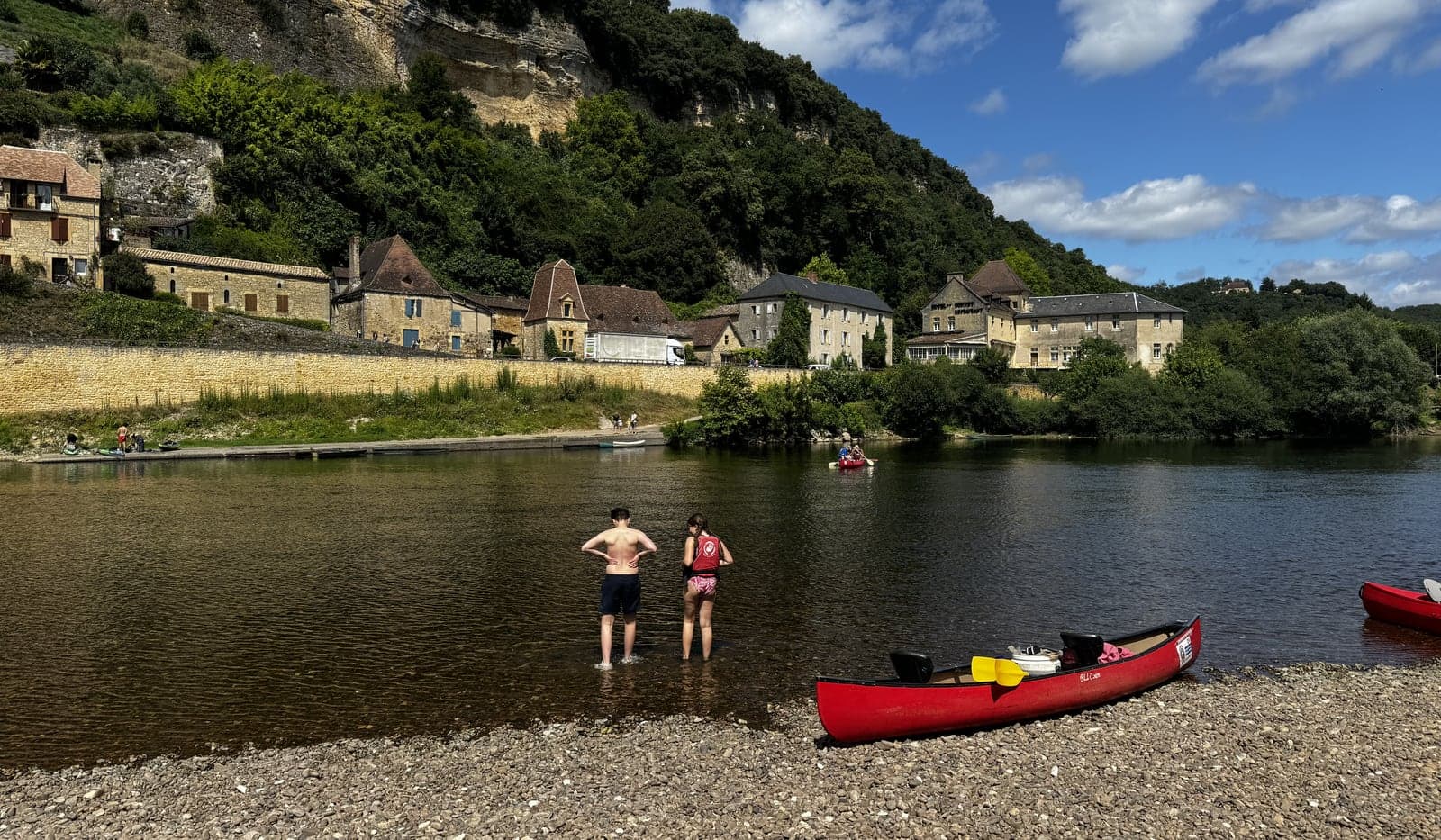
The Dordogne is a landscape that invites you to move through it — by paddle, on foot, by bike, or simply by drifting on a warm current between limestone cliffs. From river canoe routes past medieval châteaux to ridge walks through ancient oak forest, this is a region that rewards the curious and the active in equal measure. And when you return to a private villa at the end of the day, it all falls perfectly into place.
The Dordogne is not only a place to relax and indulge — it is also a place to move, explore, and reconnect with the natural world. Framed by rivers, rolling valleys, dramatic cliffs, dense forests, and sun-dappled countryside, this diverse landscape invites visitors to step outside and stay active. Whether you are here for a gentle paddle, a long ridge walk, a round of golf, or simply to swim in a cold river on a hot afternoon, the Dordogne delivers something that few other regions in France can match: genuine natural beauty, genuine peace, and a landscape that rewards curiosity at every turn. The advantage of basing yourself in a private holiday home in the countryside — rather than a hotel — is that all of it becomes easier, more spontaneous, and far more your own.
Canoeing and Kayaking: Gliding Through History
Canoeing and kayaking on the Dordogne River is one of the most iconic ways to experience this region. Paddle past towering limestone cliffs, medieval châteaux, riverside villages, and wooded banks alive with herons, kingfishers, and cormorants. The gentle current and well-marked routes make it perfectly accessible for beginners, couples, and families — yet there is enough beauty on the water to keep even seasoned paddlers entirely absorbed. The river here does not demand anything of you; it simply draws you forward, and the scenery changes almost continuously.
Canoë Roquegeoffre — Vitrac
Canoë Roquegeoffre, based at Vitrac (around 10 minutes from Sarlat), offers what many consider the definitive stretch of the river. Their classic 8 km route runs downstream past the cliff-top fortress of Beynac-et-Cazenac and directly beneath the walls of Castelnaud-la-Chapelle, the two great rival châteaux that faced each other across the water during the Hundred Years War. The symbolism of paddling between them, centuries later, on a quiet morning with the mist still on the water, is not lost. Allow two to three hours at a relaxed pace; most people take longer, stopping to drift, look upward, and photograph the same cliff from a dozen angles. Single and double canoes are available, and the company will transport you back to your start point by road. Prices typically run from around €14 per person for a single kayak, with family packages available. Arriving before 9 am in July and August means you will have long stretches of the river almost entirely to yourself — an early start from a private holiday home makes this far easier than coordinating a hotel breakfast.
Canoë Dordogne — La Roque-Gageac
Canoë Dordogne, based at La Roque-Gageac, operates a popular route of around 7 km downstream towards Beynac — a section that offers some of the most photogenic scenery on the entire river. La Roque-Gageac itself, built directly into the golden cliff face and frequently cited among the most beautiful villages in France, is a remarkable place to begin a paddle. Setting off from the village quay, with the troglodyte façades rising above you, is an experience that tends to stop people mid-stroke. The company offers canoes, kayaks, and stand-up paddleboards, with guided options for those who would like context and commentary along the way. Duration is typically 90 minutes to two and a half hours depending on pace.
Randonnée Dordogne — Multi-Day Trips
For those with more time and ambition, Randonnée Dordogne specialises in multi-day itineraries along the river. A three-day self-guided journey covering around 50 km takes paddlers through stretches of the valley rarely seen by day-trippers — quieter agricultural bends, hidden gravel banks, and reaches of the river where you may not see another canoe for an hour at a time. Camping or staying in riverside accommodation en route, with luggage transfer available, this is a genuinely memorable way to understand the scale and variety of the Dordogne valley. It is also the kind of trip that is far more naturally arranged when you have a holiday rental Dordogne as a base: you can leave a day before the paddle, return to a house rather than a hotel lobby, and decompress in your own garden with a cold drink and no schedule.
Hiking: Walk Through a Living Landscape
The Dordogne is laced with hundreds of kilometres of marked walking trails, ranging from gentle valley loops to demanding ridge routes with sweeping panoramas. The network of GR (Grande Randonnée) and PR (Petite Randonnée) paths passes through oak forest, along limestone escarpments, past Romanesque chapels, and into villages that seem to exist entirely outside modern time. When you are based in a stone farmhouse in the Périgord Noir, many of these trails begin — or can be reached within minutes — from the property itself.
GR36 and GR64
The GR36 is one of the great long-distance routes of southwest France, cutting south through the heart of the Périgord Noir from the Corrèze and passing through or near Sarlat, the Vézère Valley, and the bastide towns of the south. The full route runs for over 600 km, but day-walk sections of 15 to 20 km are easily planned using the IGN 1:25,000 maps widely available in bookshops and outdoor shops in Sarlat. The terrain shifts constantly — cultivated walnut groves giving way to dense oak canopy, ridge paths opening suddenly onto panoramic views, then descending to river-level meadows and back. The GR64 follows the valley of the Célé before joining the ancient pilgrim route towards Rocamadour, with sections that are as quiet and atmospheric as any walking in France. Both trails are well-signed and can be walked in stages over a week, making them perfectly suited to a longer family holiday Dordogne with mixed abilities in the group.
The Jardins de Marqueyssac Loop
One of the most rewarding shorter walks in the region combines the gardens of Les Jardins de Marqueyssac with the surrounding forest circuit. The gardens themselves — entry around €10 for adults, less for children — are worth an unhurried hour: 6 km of hand-clipped box hedges along cliff-edge paths, with simultaneous views of Beynac, Castelnaud, Fayrac, and Lacoste that are simply extraordinary on a clear morning. The surrounding forest loop, accessible from the same car park, extends the outing to a comfortable half-day of around 10 km and can be combined with a descent to the riverbank below. Many of our guests treat this as a full morning — gardens first, walk after, lunch back at the villa from whatever they picked up at the Sarlat market.
The Valley Walk: Beynac to La Roque-Gageac
For a linear riverside route with minimal effort and maximum reward, the valley-floor path between Beynac-et-Cazenac and La Roque-Gageac covers approximately 5 km one way and takes around 90 minutes at a relaxed pace. The path follows the north bank of the Dordogne, passing through riparian woodland and open meadow with uninterrupted views across to the southern cliffs. Swallows work the air above the water; cattle graze the floodplain meadows; the two villages anchor each end of the walk like full stops. A pre-arranged lift or taxi back from La Roque-Gageac makes this a natural half-day outing. Spring is extraordinary here — wild orchids, cowslips, and the first swifts arriving over the river in May. In September, the light on the cliffs in the late afternoon turns the limestone a deep amber, and the path is virtually empty.
Cycling: From Quiet Country Roads to Challenging Climbs
Whether you prefer leisurely rides through fields of sunflowers and tobacco or more demanding ascents through forested valleys, the Dordogne suits cyclists well. The voies vertes (greenways) that follow former railway lines are flat, car-free, and ideal for families with younger children. Quiet country lanes in the Périgord Noir carry almost no traffic outside July and August, making road cycling genuinely pleasant through most of the year. Electric bike hire is widely available in Sarlat and Belvès — typically from around €30 to €50 per day — and many of our guests find that an e-bike removes any anxiety about the hills while still covering serious ground in a day. A full kitchen means you can pack a proper picnic rather than relying on whatever is open en route, and the advantage of a private villa with outdoor space means muddy shoes and bike gear can be sorted without inconveniencing anyone.
Golf: Tee Off Amid Vineyards and Valleys
The Dordogne offers an unexpected treat for golfers — well-kept courses that are scenic, genuinely uncrowded, and often surrounded by château and vineyard country. The Golf de Sarlat la Canéda, an 18-hole course around 10 minutes from the centre of Sarlat, plays through rolling Périgord countryside with long views and well-maintained fairways. Green fees run from approximately €35 to €55 depending on season, with club hire available. The course at Château des Merles, near Mouleydier in the Bergerac wine country (around 45 minutes from Sarlat), combines golf with excellent regional cuisine and a serious wine list — a natural choice for a day that ends at the table rather than on the practice green. Spring and autumn offer cooler temperatures and lush fairways; advance booking is advisable in July and August.
Swimming and Wild Dips: Cool Off Naturally
On a hot afternoon in July, there are few finer things than sliding off a sandbar into the cold, clear water of the Dordogne. The most popular plages fluviales (river beaches) are found at Vitrac, Carsac-Aillac, and Saint-Vincent-de-Cosse — all within 20 minutes of Sarlat. The water is clean and cool, the current gentle enough for children, and the setting — golden cliffs, trailing willows, the occasional canoe drifting past — is exactly what the Dordogne dream looks like. A private pool means you can cool off whenever the mood takes you, without packing a bag or driving anywhere. Many of our guests find they use the villa pool most in the early morning and late evening, reserving the river for afternoons — and that combination, across a week, is very hard to improve upon.
Rock Climbing and Via Ferrata
The region's limestone cliffs offer serious climbing for those who seek it. The most developed area is the Céou valley near Castelnaud-la-Chapelle, with routes graded from beginner to advanced on clean, well-featured rock. For a more accessible vertical experience, the Via Ferrata de Marqueyssac is a secured cliffside route suitable for families with older children and teenagers, offering panoramic views over the Dordogne valley that you will not quickly forget. Guided sessions and equipment hire can be arranged through local outdoor companies in Sarlat and La Roque-Gageac, typically from around €40 per person including gear.
Coming Home After an Active Day
There is a specific pleasure to an active day in this landscape that is only fully realised when you return to a private home rather than a hotel. It is not simply a matter of comfort — it is a matter of rhythm. After a morning on the river, drifting past Beynac with the current, and an afternoon on the trails above the valley, stepping through the gate of a stone farmhouse into a shaded garden where the table is already set — that is something particular to the experience of staying in a private villa rather than a hotel.
The morning stop at the Sarlat market — 20 minutes away — yielded a ripe Quercy melon, a bundle of fat tomatoes still warm from the vine, some charcuterie from the Périgord Noir, and a wedge of Cabécou from a farmhouse producer whose stall you have already learned to find. The advantage of a full kitchen is that dinner does not need to be a production. Something assembled rather than cooked, eaten slowly as the garden cools and the light drops behind the treeline. A glass of Bergerac Rouge, earthy and soft, or a chilled Monbazillac alongside the cheese — that particular Dordogne combination of sweet wine and creamy chèvre that somehow always works better on a garden table than anywhere else. The sound of the countryside at dusk: a dog somewhere, cicadas if you are far enough south, the distant bell of a village church. This is the rhythm that only a private holiday home makes possible, and it is, for many people, the real reason they come back to the Dordogne year after year.
When to Go
Spring and early summer (April to June) are perfect for hiking, cycling, and river sports — wildflowers on every verge, mild temperatures, and a landscape that feels newly awake. July and August bring warm days ideal for river swimming and early-morning paddles, though popular routes are busy by mid-morning. September and October are arguably the finest months of all: golden light, cooler air, virtually no crowds, and the forests beginning to turn. For golf, trail running, and longer multi-day walking itineraries, autumn is simply hard to beat. Knowing when to go — and choosing the right base for the season — makes a considerable difference to the week.
If an active holiday rental Dordogne is what you are looking for — somewhere to base yourself between days on the river, mornings on the trails, and evenings in the garden — the DordogneCollection portfolio of handpicked luxury holiday Périgord villas is a natural place to begin. Every property in the collection has been chosen with exactly this kind of week in mind: space to move, outdoor living, and a location that puts you within easy reach of everything the region offers. Whether you are planning a family holiday Dordogne, a week for two, or a gathering of friends who all want something slightly different from their days, you will find the right home here. Browse the collection and take it from there.