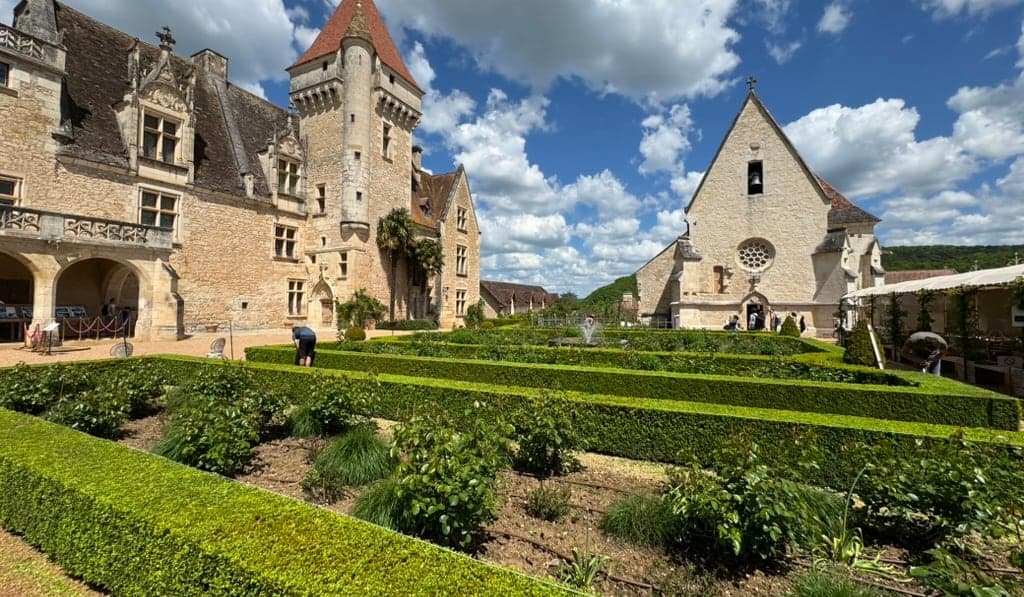
From cliff-top fortresses to candlelit topiary gardens, the Dordogne's castles and historic estates are among the finest in France. This guide takes you through the best of them — with a practical three-day itinerary, driving distances, and honest advice on what to prioritise.
The Dordogne is often described as one of the most beautiful corners of France, and when you are actually here — standing on the ramparts of a cliff-top fortress, looking down at the river glittering below — the description feels, if anything, like an understatement. With more than 1,000 castles, a string of remarkable formal gardens, and medieval villages that appear to have barely changed in five centuries, this is a region where history is not behind glass. It is all around you, and it rewards those who take the time to move through it slowly.
The concentration of significant sites along the Dordogne Valley — particularly in the Périgord Noir, the dark-forested southern stretch centred on Sarlat-la-Canéda — means that a well-planned three-day circuit can take in castles, gardens, troglodyte villages and bastide towns without ever feeling rushed. Staying in a private holiday home in the countryside rather than a hotel makes this kind of unhurried rhythm far easier: you can return at dusk, eat when you like, and plan the next day over breakfast on a terrace. Many of our guests find that three days is just enough to fall seriously in love — and to start planning a return.
What to Prioritise if You Only Have One Day
If time is genuinely short, concentrate on the stretch of river between Beynac-et-Cazenac and La Roque-Gageac. Begin at Château de Beynac when it opens (9am in summer), walk the village afterwards, then drive the 3 km across the valley to Château de Castelnaud. Lunch in the village of Castelnaud or back along the river, then spend the afternoon at the Jardins de Marqueyssac, which are just 2 km from Castelnaud. If it happens to be a Thursday evening in July or August, stay for the candlelight opening — it is one of the genuinely unmissable experiences of the Dordogne. That circuit covers roughly 15 km of driving and gives you the essential drama of the valley in a single day.
A Three-Day Castle and Garden Circuit
Day One: The Rivals and the Icon
Start the day at Château de Beynac, perched on a sheer limestone cliff above the Dordogne River. Built in the 12th century and used as a stronghold during the Hundred Years' War, Beynac was the French crown's principal fortress in the region. The English held the opposite bank. Inside, you will find austere stone halls, a Romanesque keep, a vaulted chapel, and panoramic terraces from which the logic of the landscape — and the conflict — becomes immediately clear. The village below is steep and cobbled and entirely worth the detour on the way back down. Allow 1.5 to 2 hours.
From Beynac, it is just 3 km across the river to Château de Castelnaud, the English equivalent — a restored 13th-century fortress that now houses France's most important collection of medieval arms and armour. Trebuchets, crossbows, full suits of armour, and seasonal live demonstrations of siege weaponry make this the better choice for families with children. Audio guides and children's booklets are available in English. Admission is around €11 for adults, €5.50 for children (prices vary by season). Allow 2 hours, more if the demonstrations are running.
Lunch in the village of Castelnaud, then drive 8 km west along the river to Château des Milandes, the Renaissance estate that was the beloved home of Joséphine Baker — American-born cabaret star, French Resistance agent, civil rights activist, and mother of twelve adopted children from around the world. The building itself, with its elegant turrets and decorative stonework, is lovely. But it is the museum inside that earns the visit: period rooms, personal photographs, costumes, and a genuinely moving account of an extraordinary life. The falconry shows in the grounds are a bonus. Admission around €13. Allow 2 hours.
Day one driving total: approximately 11 km between the three sites, all within easy reach of a Sarlat base (Beynac is 20 minutes from Sarlat).
Day Two: The River, the Rock, and the Bastide
Begin the morning at La Roque-Gageac, the troglodyte village built into a south-facing cliff directly above the river. It is one of the most photographed villages in France, and it earns the attention. Flat-bottomed gabarres — the traditional river boats of the Dordogne — depart from the riverbank throughout the morning for one-hour cruises that offer a unique perspective on the valley. The village itself has good cafés and is best explored on foot. La Roque-Gageac is 10 km east of Castelnaud and 12 km south of Sarlat.
From La Roque-Gageac, drive 8 km south-east to Domme, the royal bastide founded in 1281 on a plateau 150 metres above the valley floor. The views from the belvédère at the southern edge of the village are among the finest in the Dordogne — on a clear morning you can see the river looping for miles in both directions. Domme also has a covered market hall beneath which the town sheltered from the Black Death, and a network of natural caves used as a refuge during the Hundred Years' War. The town is compact; ninety minutes is comfortable. There is a good market here on Thursday mornings.
In the afternoon, drive 8 km back north-west to catch Château de Montfort, which crests a wooded spur above one of the most celebrated meanders of the Dordogne — the cingle de Montfort. The château is privately owned and not open to the interior, but the viewpoint from the road below is spectacular, and the short drive through the valley on the way there is genuinely beautiful. Combine it with a late-afternoon walk along the river at the base of the cliff.
Day two driving total: approximately 26 km in a loose loop, returning to your base in the Sarlat area.
Day Three: The Gardens
Save the third day for the gardens, which deserve a slower pace and better light. Begin at Jardins d'Eyrignac, near Salignac-Eyvigues, approximately 15 km north-east of Sarlat. These are considered among the finest formal French gardens in the country: a masterpiece of clipped yew hedges, topiary columns, hornbeam tunnels, and perfectly symmetrical allées that unfold across an 18th-century estate. There are no flowers — the entire composition is built from architecture and greenery alone — which gives it a calm, monumental quality. Admission is around €13.50 for adults. Allow 1.5 to 2 hours and go at opening time (10am) when the light is still low and the shadows long.
Drive 20 km south-west back towards the river to reach the Jardins de Marqueyssac, 4 km from Beynac. Perched on a cliff above the Dordogne, these are among the most atmospheric gardens in France — 150,000 hand-pruned boxwood shrubs shaped into organic forms that spill across terraces, shaded walks, and rocky outcrops above the valley. The belvédère at the tip of the promontory offers the finest elevated view of the river in the entire region. Admission is around €9.50 for adults. Allow 2 hours minimum.
If your third day falls on a Thursday in July or August, reorganise your afternoon accordingly: Marqueyssac opens for its celebrated soirées aux chandelles — candlelight evenings — from 7pm, with the gardens illuminated by more than 2,000 candles. It is unhurried, romantic, and unlike anything else in the region. Arrive for the last of the daylight and stay as the candles take over. Gates close at midnight.
Day three driving total: approximately 35 km including the return to base.
Château de Hautefort: Worth the Extra Drive
If you have additional days, Château de Hautefort in the Périgord Blanc, approximately 45 minutes north of Sarlat, offers a very different register. Where the valley fortresses are all drama and austerity, Hautefort is grand, aristocratic, and strikingly elegant — symmetrical towers, baroque formal gardens, a sweeping library, and fully furnished salons that tell the story of French noble life across four centuries. Candlelit summer concerts in the grounds are worth planning around. It makes an excellent full-day excursion when you are ready for a change of scenery.
Practical Notes for Visiting
- Most major sites are open daily from April through October; reduced hours and closures apply November to March — always check ahead.
- The Dordogne Valley sites cluster tightly enough that a multi-site pass (the Pass Périgord) can offer real savings if you plan to visit four or more châteaux.
- Peak visiting hours at Beynac and Castelnaud are 11am to 2pm in July and August. Arrive at opening or after 3pm.
- The advantage of a full kitchen when staying in a private villa is that you can pack a proper picnic — the riverside pull-offs between La Roque-Gageac and Beynac are some of the best picnic spots in France.
- Good walking shoes are essential for both Beynac village and the upper paths at Marqueyssac.
- A private pool means you always have somewhere cool to return to after an afternoon in the summer heat — the valley can be genuinely warm in July and August.
Frequently Asked Questions
How long does it take to visit Château de Beynac?
Allow at least 1.5 hours for the château itself, plus extra time for the village of Beynac-et-Cazenac on the way back down. The climb from the car park to the entrance is steep — around 15 minutes on foot — so factor that in if you are visiting with young children or anyone with limited mobility. The views from the keep are worth every step.
Is Château de Castelnaud suitable for children?
It is one of the best family destinations in the Dordogne. The medieval weapons collection is genuinely engaging for older children, and the seasonal live demonstrations of trebuchets and crossbows tend to go down extremely well. Children's activity booklets are available in English and French. Admission for children under 10 is free; reduced rates apply up to age 17.
When are the Marqueyssac candlelight evenings?
The soirées aux chandelles at Jardins de Marqueyssac take place every Thursday evening throughout July and August, from 7pm until midnight. The gardens are lit by more than 2,000 candles along the paths and terraces. Entry is around €13 for adults. It is worth organising your weekly itinerary to ensure Thursday evening is free — this is one of the genuinely special experiences of a luxury holiday in Périgord.
How far are these sites from Sarlat?
Sarlat-la-Canéda is the ideal base for this circuit. Beynac is 20 minutes south-west; Castelnaud a further 5 minutes beyond that; Les Milandes another 10 minutes west. Marqueyssac is about 25 minutes from Sarlat. La Roque-Gageac and Domme are both within 15 minutes. Jardins d'Eyrignac is 20 minutes north-east. All distances are comfortable for day trips from a holiday rental Dordogne base.
Do I need to book tickets in advance?
In peak summer (mid-July to mid-August), booking Château de Castelnaud and Jardins de Marqueyssac online in advance is advisable, particularly for Thursday candlelight evenings which sell out. Beynac and Les Milandes are generally fine without pre-booking, though arriving early always helps. Jardins d'Eyrignac rarely has queuing issues and tickets can be bought on the day.
Is there a good route that combines castles and gardens in a single day?
Yes — the one-day circuit described above works well: Beynac in the morning, Castelnaud before lunch, then Marqueyssac in the afternoon (staying for the candlelight evening if it is a Thursday). This keeps driving to under 15 km and gives you the best of the valley. When you are based in a stone farmhouse or villa nearby, the logistics are simple and you are back in time for a late dinner at home.
Are the gardens of Eyrignac and Marqueyssac very different from each other?
Completely different, which is why they work well as a pairing. Eyrignac is formal, architectural, and designed around symmetry and geometry — no flowers, all structure. Marqueyssac is wilder in spirit, built on a dramatic promontory with organic topiary shapes, forested paths, and a strong sense of landscape and cliff. Both reward slow exploration. If you only have time for one, Marqueyssac has the more dramatic setting; Eyrignac has the finer formal craftsmanship.
Where should we stay to make the most of this circuit?
A villa with pool Dordogne in the Périgord Noir — ideally within 20 minutes of Sarlat — puts you at the centre of everything. Staying in a private villa rather than a hotel gives you the flexibility to adjust your days around the weather, the markets, and your own pace. Many of our guests find that having a private terrace for evening meals, after a long day at the châteaux, transforms the whole experience from a trip into something that genuinely feels like a way of living, if only for a week.
The Dordogne's castles and gardens are not a checklist — they are an invitation to move through one of Europe's most layered and quietly magnificent landscapes at your own speed. Whether you have a single afternoon or a full week, the valley rewards curiosity and unhurried attention in equal measure. Browse the DordogneCollection portfolio of hand-selected holiday properties in the Périgord Noir to find a private base that puts the very best of this region within easy reach — and makes coming home at the end of the day a pleasure in itself.